Heat Dissipation Policy: Diffusion That Forgets Structure Like a Hot Object Forgets Its Shape
Sakib Chowdhury
Stevens Institute of Technology
Unpublished
Standard diffusion corrupts data with i.i.d. Gaussian noise, destroying every frequency at the same rate.
The Heat Dissipation Policy corrupts action trajectories with the heat equation instead — a physical
process that erases fine detail first and coarse structure last, for free.
û(k, t) = û(k, 0) · exp(−2π²σ(t)²|k|²)
Forward corruption in Fourier space — the attenuation factor is exactly 1 at k=0, for every σ
Standard diffusion corrupts a trajectory with i.i.d. Gaussian noise and learns to reverse it — every
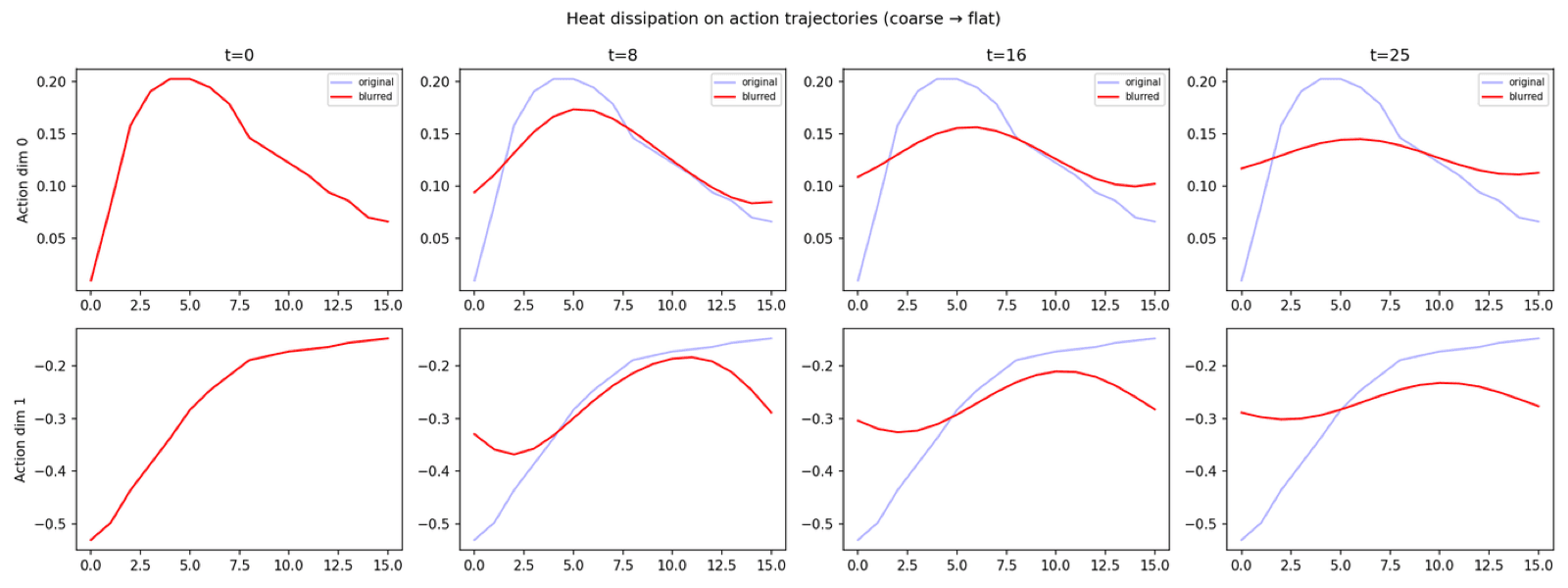
frequency destroyed at the same rate. The heat equation destroys structure differently: high frequencies
die first, low frequencies survive longest. Applied to an action chunk instead of an image, that ordering
is a coarse-to-fine motion plan for free — the rough trajectory shape is recoverable from very few
reverse steps, fine corrections come last.
clean action a0—heat blur→low-freq aT
atmodel predictsâ0—re-blur to t−1→at−1
The forward heat process on an action chunk: FFT-based blur removes high-frequency detail first while conserving the trajectory's total mass exactly.
σ(t) is spaced as √(linspace(σmin², σmax², T)) rather
than linearly. A linear schedule in σ is quadratic in the exponent, so it front-loads almost all the
information destruction into the first few steps and wastes the rest of the schedule on an already-flat
signal — the sqrt schedule destroys detail at a uniform rate across all T steps, the same reasoning
that motivates cosine noise schedules in standard diffusion.
Aspect
Diffusion Policy
Heat Dissipation Policy
Forward corruption
add i.i.d. Gaussian noise
blur with the heat kernel (FFT multiply)
Frequency treatment
every frequency corrupted equally
high frequencies die first, low frequencies survive longest
Network predicts
noise ε, then a0 = at − ε
clean signal â0 directly
Mass conservation
not applicable
exact — the zero-frequency (DC) term is untouched by construction
Structure at few steps
unstructured partial denoise
coarse-to-fine — a valid rough plan after very few reverse steps
DC Augmentation Isn't a Tuning Knob — It's a Precondition
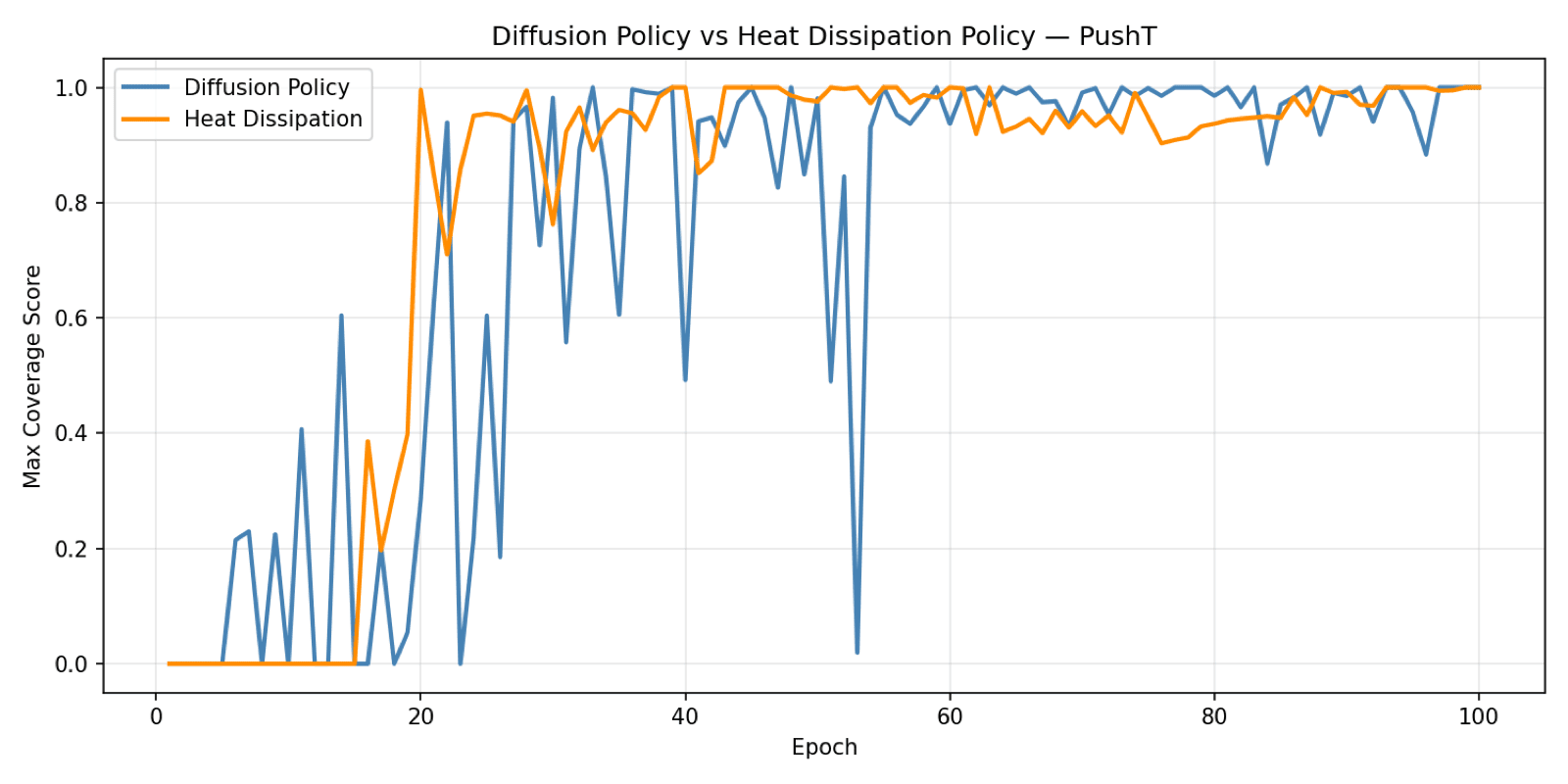
Trained the naive way
Eval score sits at 0.000 for all 100 epochs. The fix: randomize the DC component (the
zero-frequency / mean offset) of each training action chunk, forcing the model to handle arbitrary
offsets rather than the one it happened to see. With DC augmentation, the same architecture climbs to a
best eval score of 0.857.
The reason: the heat kernel's attenuation factor exp(−2π²σ²|k|²) equals
exactly 1 at k=0 for every σ. The DC term — the chunk's mean offset — is
mathematically untouched by the forward process at any noise level. If every training chunk shares
close to the same mean, the network is never asked to denoise a different one, and at test time an
unfamiliar offset falls entirely outside what it ever learned to reconstruct.
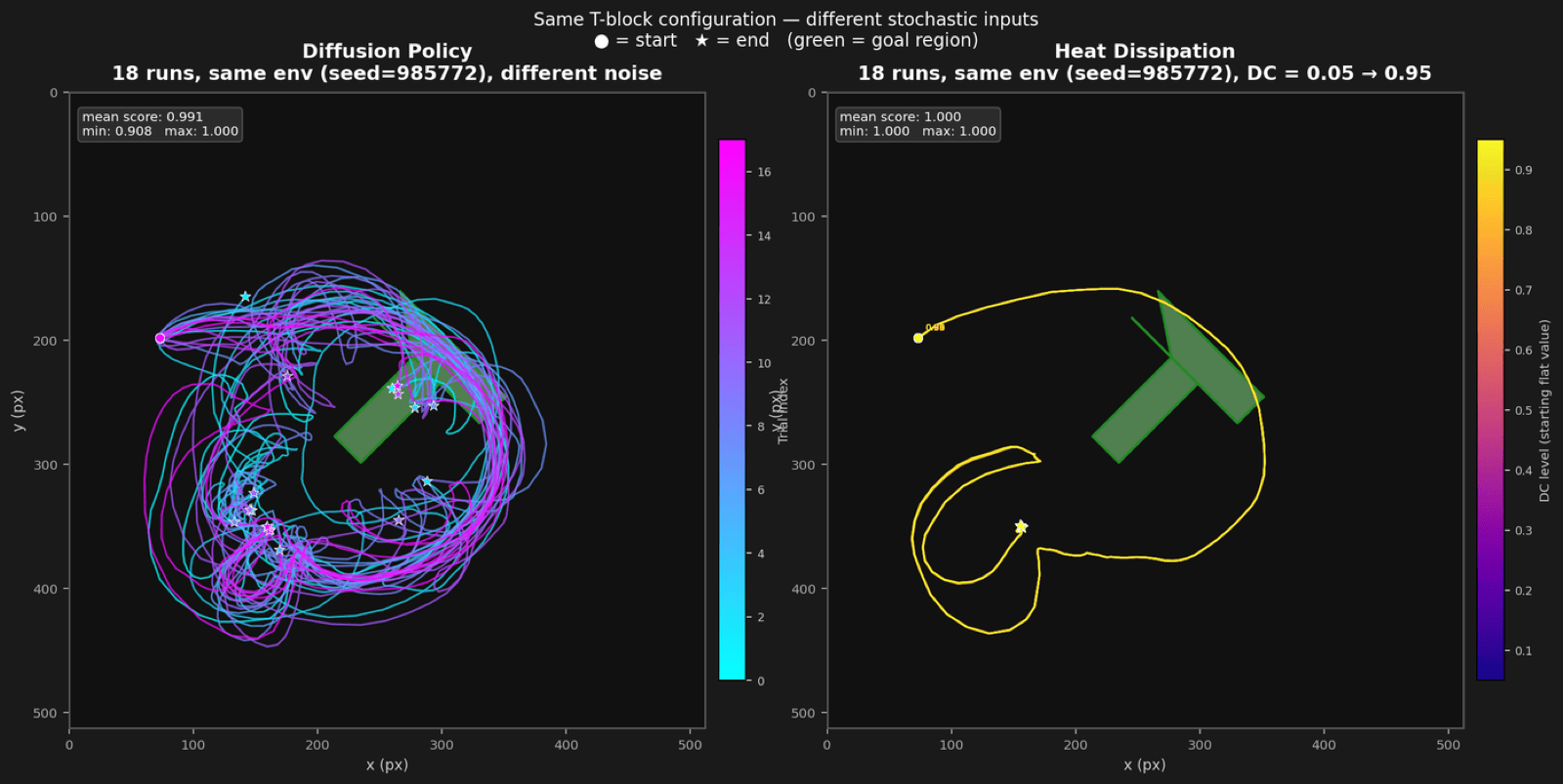
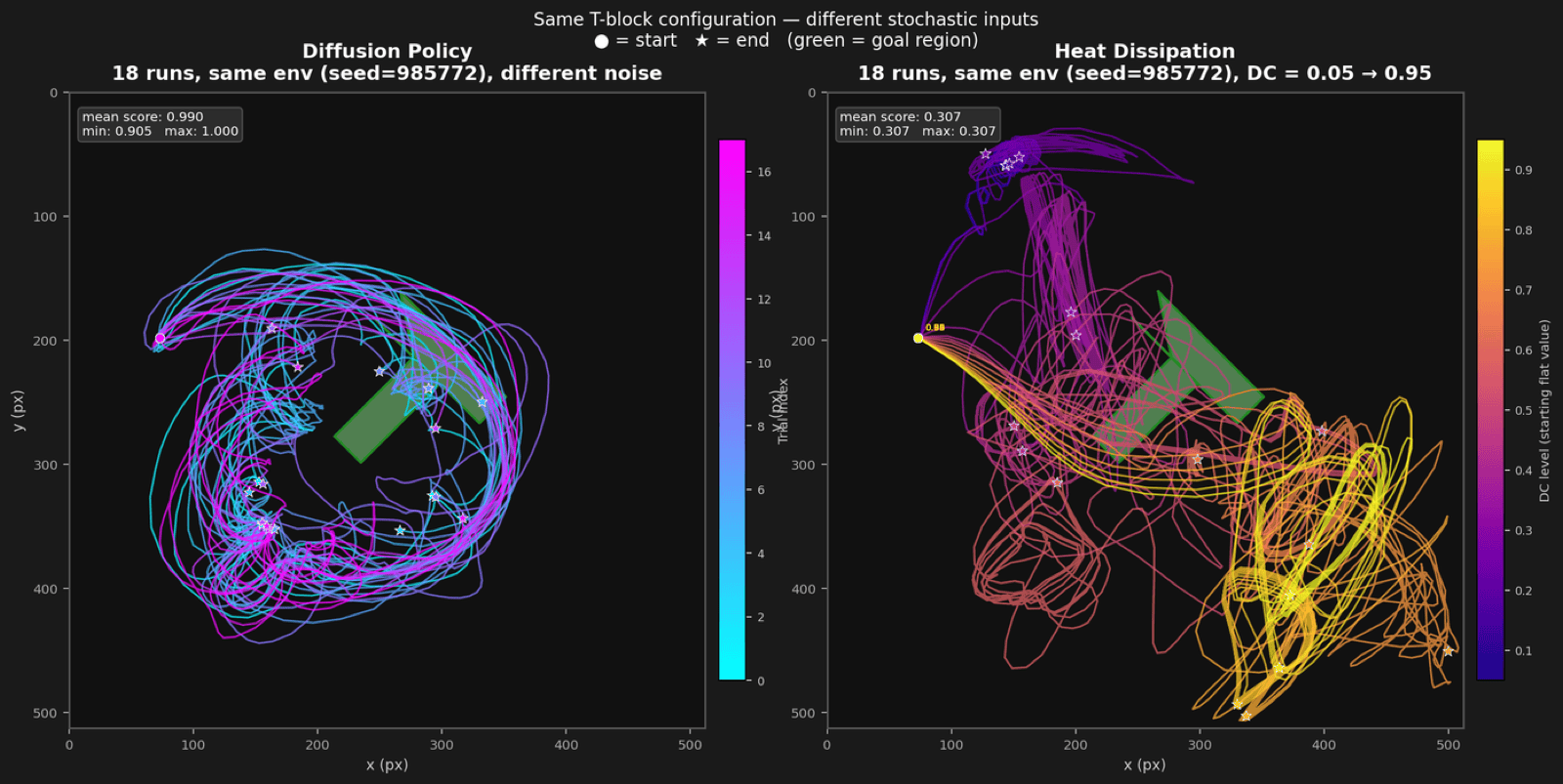
Same environment, 18 different noise draws
Freeze one Push-T configuration and vary only the random seed for Diffusion Policy, or only the
training-time DC offset (0.05 → 0.95) for Heat Dissipation. A robust policy's behavior on a fixed
environment shouldn't hinge on either.
Left, DC-augmented: all 18 DC offsets converge to essentially the same trajectory — mean score 1.000,
min 1.000, max 1.000. As consistent as Diffusion Policy's own noise sweep. Right, without DC augmentation:
trajectories fan out by DC value into unrelated paths — mean score collapses to 0.307. The policy is
accidentally reading out a value that should be irrelevant.
Training loss (log scale) and eval score per epoch, 100 epochs, DC-augmented run. Heat Dissipation's loss falls faster and lower, and its eval score climbs to parity with Diffusion Policy after the DC fix.
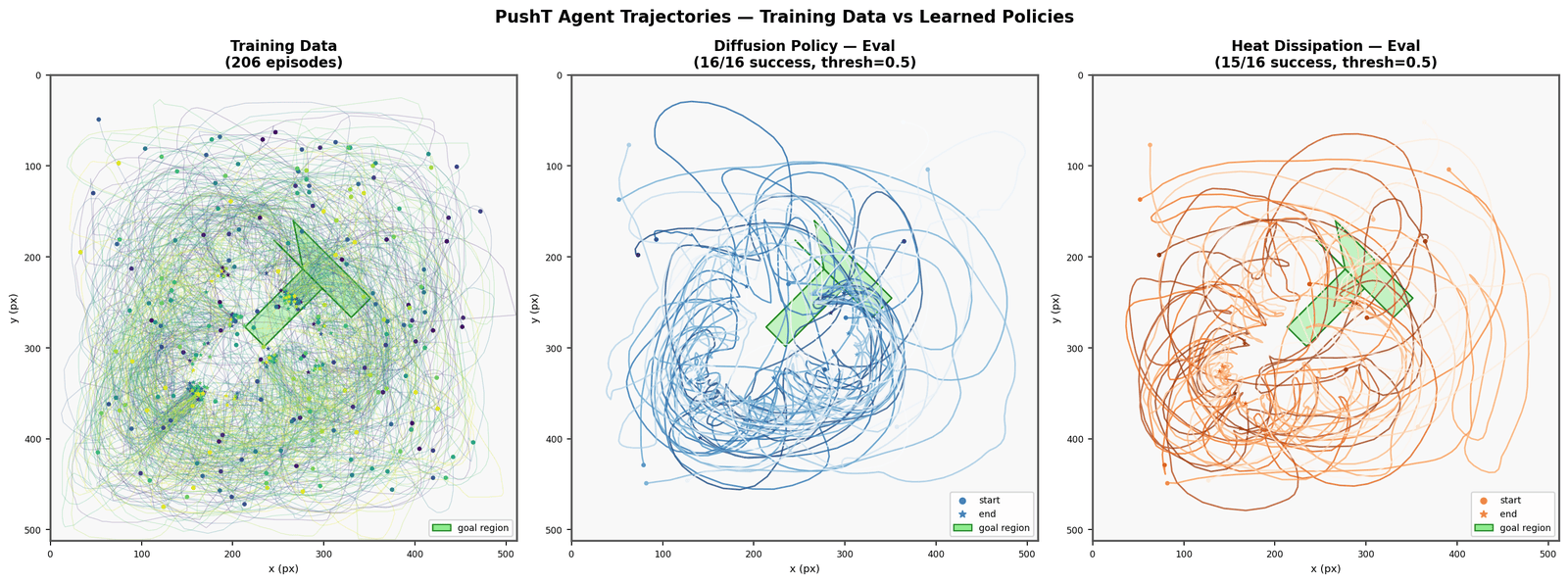
All 16 eval rollouts overlaid, against the 206-episode training set. Diffusion Policy: 16/16 above the 0.5 threshold. Heat Dissipation: 15/16 — both produce the same tangled, exploratory sweep-and-push pattern the human demonstrations show, rather than a single clean line.
Head-to-head on 16 held-out seeds
Once DC-augmented, Heat Dissipation is competitive with — if slightly behind — standard
Diffusion Policy: mean score 0.912 vs. 0.982, and it outright wins on 6 of 16 seeds. One clear failure
mode remains (seed 435829, below).
mean DP = 0.982 · mean Heat = 0.912 · n = 16 seeds · Heat wins 6, DP wins 7, ties 3
Does the DC-Augmented Policy Hold Up Off-Distribution?
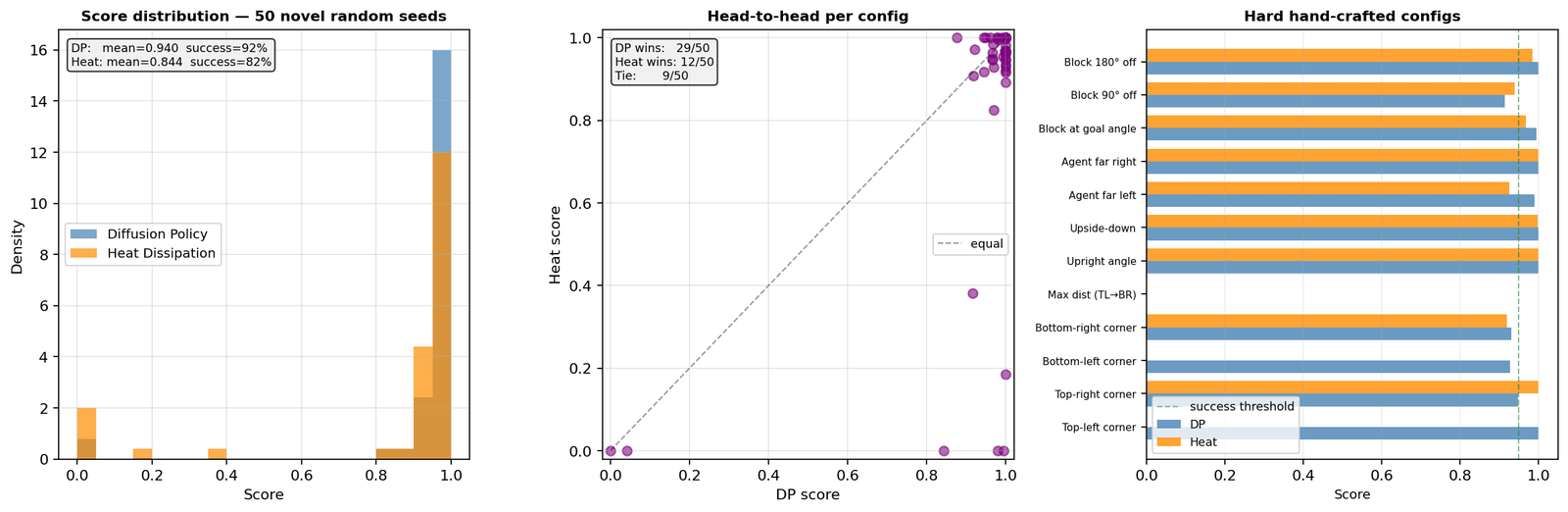
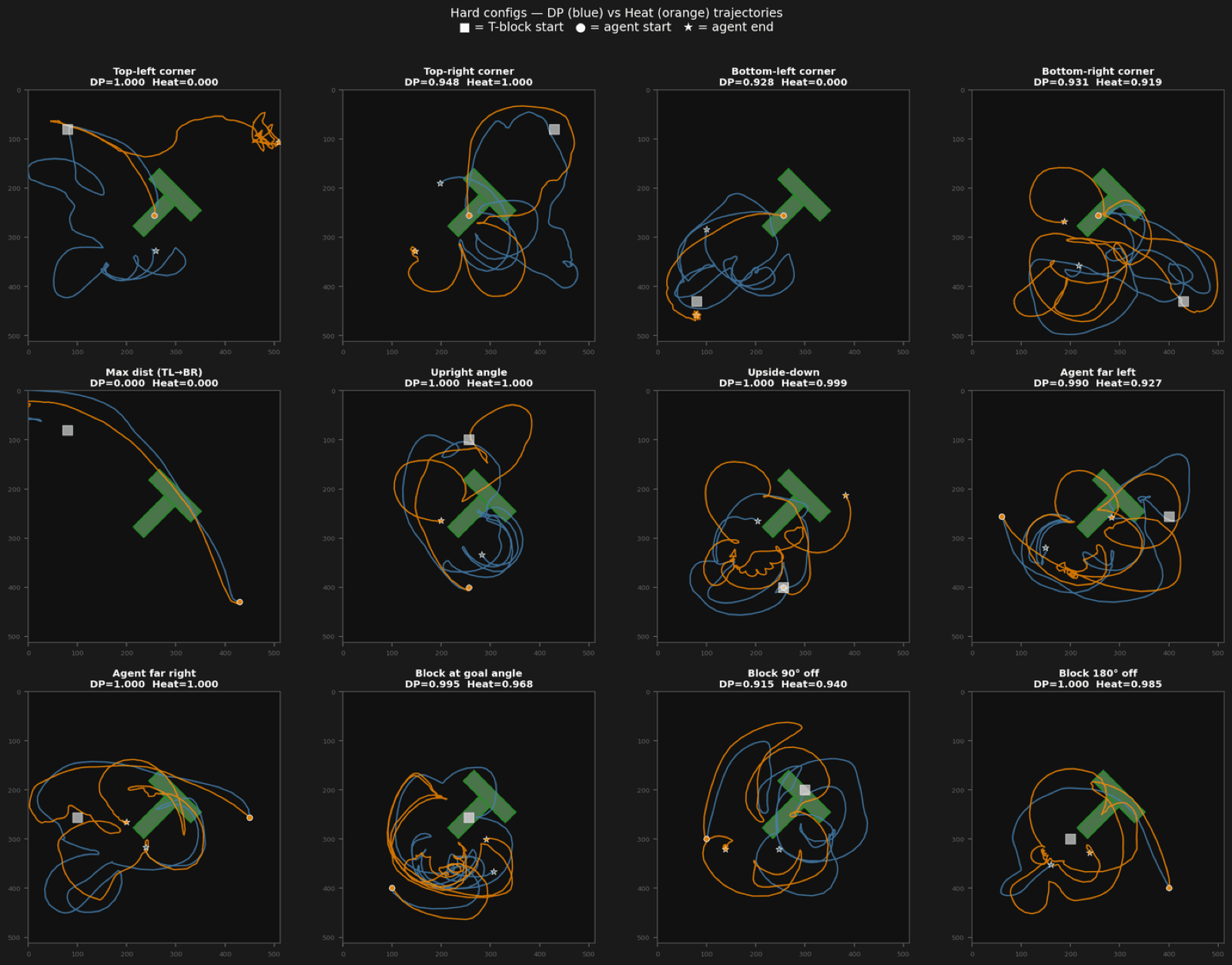
Two follow-up evaluations: a 50-seed random batch, and a hand-built set of hard cases — the T-block
starting in corners, at extreme angles, in configurations the training distribution rarely produced.
Left — score distribution across 50 random seeds; Heat's spread is wider than DP's, consistent with the single hard failure seen in the 16-seed table. Right — hand-crafted hard configurations (corner starts, extreme block angles), run side-by-side for both policies.
The Same Corruption Process, Applied to Pixels
If the heat kernel works as a forward process for 1D action trajectories, the same math applies to images
and video frames.
Heat dissipation image generation — the direct 2D analogue: blur an image with the heat kernel instead of adding Gaussian noise, then learn to reverse it. Closely related to Cold Diffusion (Bansal et al., 2022) and Blurring Diffusion Models (Hoogeboom & Salimans, 2023) — now its own dedicated write-up, Heat Dissipation Image Generation.
Entropy-conserving generation — a different idea: instead of traversing an entropy gradient, move along a constant-entropy manifold. A phase-shuffled image has identical spectral entropy to its source but no structure; a model can be trained to reorganize shuffled → coherent while conserving entropy exactly. Unexplored in the literature as far as I've found.
Entropy conservation for video — consecutive frames have near-constant entropy by nature, which makes the constant-entropy idea a plausible fit for temporal consistency in video generation — tested in Constant-Entropy Video Generation, including where it does and doesn't hold up.